
Article Table of Contents
I. Introduction: Beyond Commodity Pricing – Navigating the Custom Yarn Landscape in China
II. Defining “Custom Dyed Yarn” and Its Value Proposition
III. The Comprehensive Cost Structure of Custom Dyeing in China
IV. The 8 Primary Determinants of Custom Yarn Pricing: A Technical Breakdown
V. Price Analysis by Fiber Category and Application
VI. Strategic Sourcing: How to Get the Best Value, Not Just the Lowest Price
VII. Quality, Compliance, and Risk: The Hidden Costs of Customization
VIII. Future Trends Impacting Cost and Availability
IX. Conclusion: Making Informed Investment Decisions
X. FAQ: Critical Questions for International Buyers
Article
I. Introduction: Beyond Commodity Pricing – Navigating the Custom Yarn Landscape in China
For global sourcing professionals in the textile industry, China remains an unparalleled hub for manufacturing, but its market for custom dyed yarn is often perceived as a complex puzzle of fluctuating prices.What is the price of custom dyed yarn in China? The question, “What is the price?” rarely has a simple answer because custom dyeing is a service of transformation, not a commodity transaction. The final cost is a direct reflection of technical specifications, logistical complexity, and value-added services. This guide deconstructs the pricing matrix of custom dyed yarn in China, moving beyond superficial quotes to provide a strategic framework for budgeting, negotiation, and supplier partnership. Whether you are developing a high-fashion collection, a durable carpet line, or safe, vibrant yarn for toys, understanding these cost drivers is essential for maximizing your return on investment and ensuring supply chain reliability.
II. Defining “Custom Dyed Yarn” and Its Value Proposition
Custom dyed yarn refers to yarn that is dyed to a specific, buyer-defined color standard after the yarn has been spun, as opposed to using pre-dyed fibers (solution dyeing) or purchasing stock colors. This process typically occurs on package dyeing or skein dyeing machines. The core value propositions are:
- Precision Color Matching: Achieving exact brand-specific or design-specific shades that stock colors cannot provide.
- Small-Batch Agility: Enabling production of limited collections or initial orders without the massive minimums required for fiber dyeing.
- Material Flexibility: Allowing a wide range of natural, synthetic, and blended yarns to be colored after spinning, which is crucial for blended fabrics (e.g., cotton-polyester-wool).
- Design Integrity: Ensuring color consistency across different yarn types and fabric structures within a single product.
III. The Comprehensive Cost Structure of Custom Dyeing in China
The total cost (CIF or FOB) is an aggregation of multiple components:
1. Base Yarn Cost: The starting point, determined by the raw material (e.g., combed Egyptian cotton vs. standard Asian cotton, virgin polyester vs. recycled PET).
2. Dyeing Service Fee: The core processing charge. This is not linear; it involves:
* Lab Dip Development: As detailed in the previous article, creating the color recipe.
* Dye & Chemical Cost: The price of dyes (reactive, acid, disperse) and auxiliaries, which varies dramatically with color depth and fastness requirements.
* Processing Cost: Energy (steam, electricity), water, labor, and equipment amortization tied to the dyeing cycle time.
3. Minimum Order Quantity (MOQ) Surcharge: Most dye houses have an economic MOQ per color, often 500kg to 2,000kg. Orders below this incur a “small batch” surcharge, which can increase the per-kg cost by 20-50%.
4. Testing and Certification: Charges for colorfastness (wash, light, rub), pH, and eco-certifications (OEKO-TEX, GOTS) are almost always extra.
5. Logistics & Packaging: Special packaging for export, palletizing, and documentation.
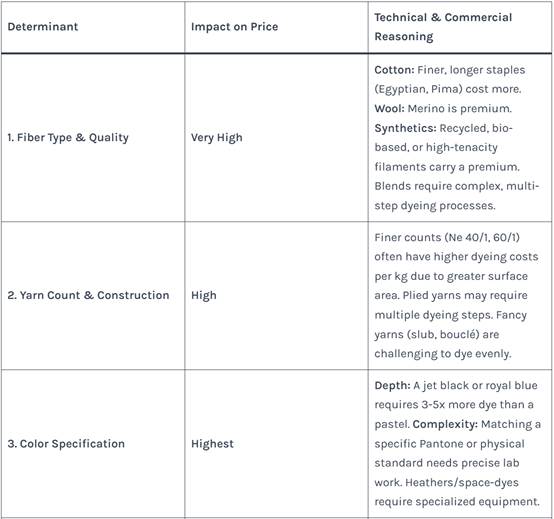
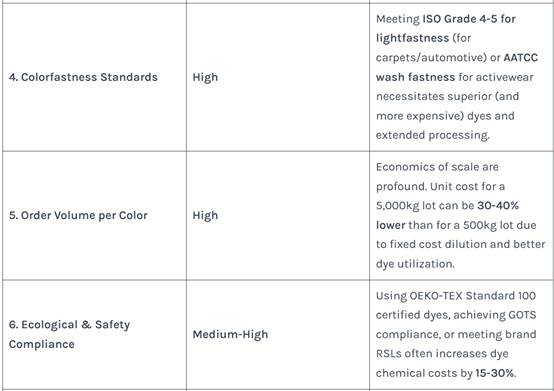
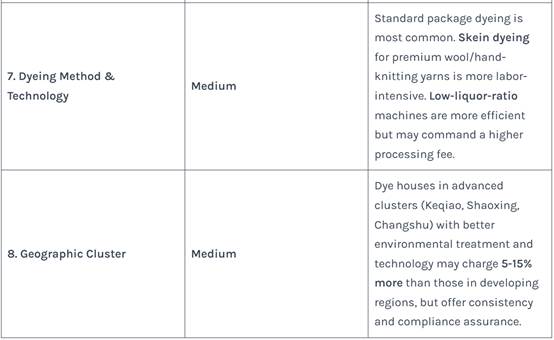
IV. The 8 Primary Determinants of Custom Yarn Pricing: A Technical Breakdown
V. Price Analysis by Fiber Category and Application
Table: Indicative Price Ranges for Custom Dyed Yarn (FOB China, Medium Volume)
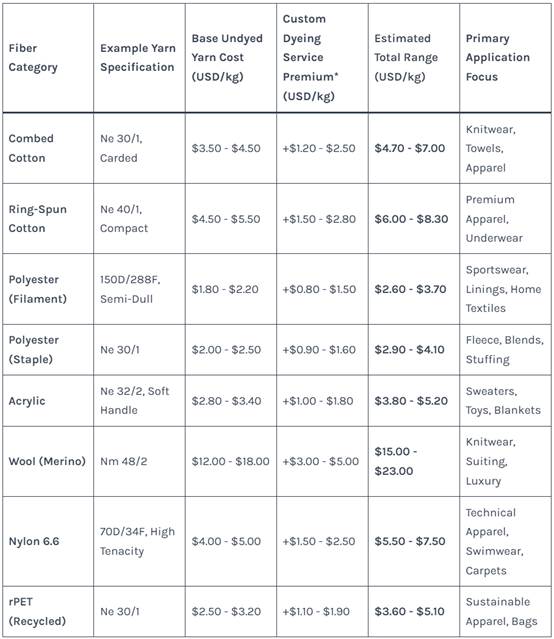
Note: The “Dyeing Service Premium” covers the dyeing process, standard colorfastness, and lab dip. It increases significantly for deep/dark shades, small MOQs, and premium fastness tests.
VI. Strategic Sourcing: How to Get the Best Value, Not Just the Lowest Price
- Consolidate and Forecast: Combine color needs across product lines to achieve larger per-color volumes. Forecast accurately to avoid costly small-batch top-ups.
- Invest in Technical Dialogue: Provide a physical color standard and clearly communicate all fastness and compliance requirements upfront. This prevents costly re-dyeing.
- Audit for True Capability: Visit or audit potential suppliers. A dye house with a modern laboratory, wastewater treatment, and color management software will provide better consistency, saving money on rejected batches.
- Consider Vertical Partners: Sourcing from a vertically integrated mill (spinning + dyeing) can sometimes offer better coordination and cost control than using separate spinners and commission dyers.
VII. Quality, Compliance, and Risk: The Hidden Costs of Customization
The cheapest quote often carries hidden risks:
- Inconsistent Dyeing: Improperly calibrated machines lead to lot-to-lot variation, causing production headaches.
- Substandard Chemicals: Use of non-compliant dyes can lead to failed RohS, REACH, or CPSIA tests, resulting in detained shipments or recalls.
- Environmental Non-Compliance: Partnering with a non-compliant dye house risks supply disruption and reputational damage.
VIII. Future Trends Impacting Cost and Availability
- Sustainability Premium: Demand for Global Recycled Standard (GRS) certified yarns and low-impact dyeing will command a stable premium.
- Digitalization: AI-assisted color matching will reduce lab dip time and cost but may be offered as a premium service initially.
- Regulatory Tightening: Stricter environmental enforcement in China’s industrial regions will push base processing costs up, but also drive industry consolidation towards more reliable, technologically advanced suppliers.
IX. Making Informed Investment Decisions
The price of custom dyed yarn in China is a function of specification, volume, and compliance. By moving the conversation from “price per kg” to “total cost of ownership” (including risk, consistency, and reliability), international buyers can build partnerships that deliver true value. The goal is not to find the cheapest dyer, but to identify the most competent and transparent partner for your specific technical and commercial needs, ensuring that your custom colors become a source of competitive advantage, not supply chain failure.
X. FAQ: Critical Questions for International Buyers
- Q: What is a realistic minimum budget to develop a new custom color?
A: For a standard color on a common fiber (e.g., cotton), budget $300 – $800 for lab dip development and a first sample batch of 50-100kg. For complex colors or specialty fibers, budget $1,000+. - Q: How are price increases for raw materials (like cotton) typically handled?
A: For custom dyeing, the base yarn cost is usually quoted with validity (e.g., 30 days). The dyeing service fee may be more stable. Contracts should specify how material cost fluctuations are passed on after a quote expires. - Q: Can I get a firm FOB price before doing a lab dip?
A: You can get an estimate, but a firm quote should only be issued after the lab dip is approved, as the final dye recipe determines the exact chemical cost. Insist on a detailed, line-item quote. - Q: Who owns the color formula developed during the lab dip process?
A: Typically, the dye house retains the formula for production purposes. However, you own the color standard. If you switch suppliers, you must provide the standard, and the new dyer will create a new (and potentially different) formula. For critical colors, discuss IP ownership upfront. - Q: What is the lead time for custom dyed yarn?
A: After lab dip approval: 4-6 weeks is standard for medium orders. This includes scheduling in the dye house, dyeing, drying, conditioning, and testing. Small batches or complex colors may take longer. - Q: How do I ensure color consistency between my lab dip and bulk order?
A: The approved lab dip and its associated Delta-E report are the legal contract. Reputable dyers use spectrophotometers and batch correction software to match it. Ensure your supplier conducts inline shading additions and submits a bulk production sample before shipping. - Q: Are there extra costs for “eco-friendly” dyeing?
A: Yes. Processes using certified low-impact dyes, achieving higher water efficiency, or requiring GRS certification for recycled content typically add 10-25% to the dyeing service premium. - Q: What payment terms are typical in China for custom dyeing?
A: For new clients: 30-50% deposit with order, balance before shipment. For established relationships: 30% deposit, 70% against copy of Bill of Lading (or Telex Transfer). Letters of Credit are common but add complexity and cost.